

A CryptoTotem Guide to Merchant Checkout, Stablecoin Settlement, Provider Risk, and Real Payment Operations
Crypto payment gateways help businesses accept Bitcoin, stablecoins, and other cryptocurrencies through checkout pages, invoices, ecommerce plugins, APIs, or self-hosted payment flows. The useful question is not simply which provider supports the most coins. It is whether the gateway can keep checkout, settlement, compliance, refunds, reconciliation, and support understandable when a real customer payment goes wrong.
Crypto payments are no longer just a niche checkout experiment. According to EY-Parthenon’s 2025 stablecoin survey, 54% of organizations that were not yet using stablecoins expected to start within 6-12 months. Current stablecoin users also pointed heavily to B2B and cross-border use cases, not only consumer checkout.
The practical promise is clear: crypto and stablecoin payments can reduce some card, payout, and cross-border friction. The operational reality is stricter: merchants still need to verify fees, settlement, KYB, supported countries, refunds, accounting, and compliance before going live.
Top Crypto Payment Gateways Compared
The table below gives a quick buyer-oriented view of each crypto payment gateway. Use the Description column for the provider summary, then check Best Fit and Key Checks to understand where each option may work best and what should be verified before choosing it.
| Payment Gateway | Best Fit | Key Highlights | Key Checks | Description | |
|---|---|---|---|---|---|
 |
Gate.io Pay | Exchange-native crypto payments for merchants that want access to the Gate.io ecosystem. | Gate.io ecosystem payments; QR-style crypto payment flow; exchange-linked user base. | Merchant availability; supported regions; supported assets; settlement model; account requirements. | Gate.io Pay is a crypto payment option connected to the Gate.io exchange ecosystem. It may fit merchants that want exchange-native checkout for customers already using Gate.io products. Before choosing it, verify current merchant access, supported assets, regional availability, integration options, and settlement rules. |
 |
CCPayment | Comprehensive crypto gateway with broad asset support, automated stablecoin settlements, standard fiat off-ramp solutions, customizable white-label wallets, and mass payout tools. | Advertises 900+ cryptocurrencies; 0.2% fee positioning; FinCEN MSB registered; AI-assisted API integrations; auto-swap & auto-withdrawal; crypto-to-fiat off-ramps; branded Wallet API; mass payouts/payroll support. | Current coin/fiat count; exact fee tiers; off-ramp availability; custody model; integration documentation; minimum withdrawal amounts. | CCPayment is an API-first crypto payment provider for merchants that need payment links, wallet APIs, invoicing, auto-swap, mass payouts, and settlement workflow automation. It is well-suited for businesses requiring broad asset support and developer-friendly infrastructure, such as AI-assisted tools and custom-branded wallets. |
 |
MixPay | Exchange-partnered crypto checkout with stablecoin auto-conversion. | Advertises 20+ blockchains and 100+ crypto assets; Binance, Gate, KuCoin, and Bybit Pay partner positioning; stablecoin auto-conversion; non-custodial or managed-custody setup. | Pricing terms; custody model; supported blockchains; merchant eligibility; settlement currency. | MixPay is a crypto payment infrastructure provider for merchants that want exchange-partnered checkout and stablecoin-oriented settlement. It can be useful for businesses that need multi-asset payment acceptance, real-time conversion, and flexible custody options. Verify current pricing, supported chains, custody setup, and merchant eligibility before integration. |
 |
Coinremitter | Low-fee crypto-only payments with APIs, widgets, and plugins. | Advertises 0.23% processing fee; no-KYC onboarding positioning; APIs, plugins, invoices, widgets, payment pages, and webhook notifications. | Supported coins by plan; KYC/compliance status; withdrawal fees; webhook/API limits; premium plan requirements. | Coinremitter is a crypto payment gateway for businesses that want crypto-only payment acceptance with developer tools and ready-made merchant widgets. It may fit small and mid-sized businesses that need APIs, plugins, invoices, and webhook-based payment notifications. Check current KYC rules, supported coins, fee schedule, withdrawal terms, and plan limits before relying on advertised terms. |
 |
Nicky | Non-custodial wallet-agnostic payments for merchants that want fund control. | Non-custodial model; wallet-agnostic setup; direct wallet routing; connected-wallet conversion and bank-withdrawal options where available. | Supported wallets; fiat conversion route; bank withdrawal availability by country; plugin availability; transaction fee threshold. | Nicky gives merchants a way to accept crypto payments while keeping control of their own wallet setup. It is useful for businesses that prefer non-custodial, wallet-agnostic payment routing instead of a fully managed gateway. Verify supported wallets, plugins, fiat conversion routes, bank withdrawal availability, and country-specific limitations. |
 |
Sheepy | API and invoice crypto checkout with conversion, reporting, and AML/KYT-aware operations. | Invoices; dashboard; reporting; API and ecommerce plugins; recurring payments; crypto-to-fiat or crypto retention options; AML/KYT positioning. | Supported crypto list; fiat settlement availability; payout products; API/plugin fit; KYT/AML coverage. | Sheepy is a crypto payment gateway for online businesses that need invoices, dashboards, reporting, API access, and payment-flow customization. It may fit merchants that want checkout plus operational tools such as recurring billing, conversion options, and risk-aware payment monitoring. Confirm supported assets, fiat settlement, payout capabilities, and compliance coverage for the specific business model. |
 |
KuCoin Pay | Exchange-native payments for merchants targeting KuCoin users. | Advertises 40M+ global user reach; instant payments; real-time risk controls; lower-cost off-chain payment positioning; 24/7 support. | Merchant onboarding; account requirements; supported regions; off-chain payment mechanics; supported currencies. | KuCoin Pay is an exchange-native crypto payment solution for merchants that want to reach customers inside or near the KuCoin ecosystem. Its strongest commercial angle is user reach and account-based payment convenience. Verify current merchant onboarding, supported regions, off-chain payment rules, supported currencies, and actual fee model before using it in production. |
 |
Binance Pay | Binance ecosystem QR and API payments for merchants. | Binance ID based payments; QR merchant acquiring; advertised 80+ currency support; auto-conversion between payment and order currency; account-based checkout flow. | Supported currencies; merchant eligibility; country restrictions; QR/API integration; settlement and conversion rules. | Binance Pay is a contactless crypto payment technology connected to the Binance ecosystem. It may fit merchants targeting markets where Binance users are common and account-based QR payment flows feel natural. Check current merchant access, supported currencies, regional restrictions, conversion rules, and settlement workflow before launch. |
 |
Bybit Pay | Bybit ecosystem payment flows for Web2 and Web3 merchants. | Exchange-linked payment flow; QR payment positioning; fast in-ecosystem processing; merchant payments; reduced-fee positioning compared with traditional crypto transfers. | Merchant access; supported countries; supported assets; QR/API options; settlement and fee model. | Bybit Pay is a crypto payment solution connected to the Bybit ecosystem. It may work for merchants that want exchange-linked payment flows and customer access through a familiar trading platform. Verify merchant availability, supported assets, QR/API options, settlement terms, fees, and regional restrictions before relying on it. |
 |
Crypto.com Pay | Crypto.com ecosystem checkout and brand-recognizable crypto payments. | Exchange-linked checkout; online and in-store payment positioning; crypto or fiat settlement options; hosted checkout, API, and ecommerce plugin positioning; zero-fee claims in some cases. | Merchant availability; fees; settlement currencies; plugin availability; supported regions; supported assets. | Crypto.com Pay is a merchant payment option connected to the Crypto.com ecosystem. It can be useful for businesses that want recognizable exchange-linked checkout and access to Crypto.com users. Verify current merchant eligibility, fees, fiat settlement, supported assets, plugin availability, and regional support before publishing exact terms. |
 |
CoinGate | Established gateway for APIs, plugins, billing, payouts, and settlement options. | Founded in 2014; regulated gateway positioning; API, plugins, and billing; advertised 1% processing fee; 0% conversion positioning; payout and conversion tools. | Current pricing; licensing/regulatory status; supported countries; payout availability; settlement currencies. | CoinGate is a long-running crypto payment gateway for merchants that need checkout, APIs, ecommerce plugins, billing, payouts, and settlement options. Its commercial appeal is the mix of gateway, payout, and conversion tools in one merchant platform. Verify current pricing, regulatory status, supported countries, payout fees, and settlement currencies before using exact claims. |
 |
Calypso Pay | B2B invoices, payouts, widgets, dashboard, KYT, and stablecoin conversion. | Invoices; payment widgets and links; payouts and mass payouts; dashboard; role-based access; stablecoin auto-conversion; built-in KYT and compliance positioning. | KYB terms; supported industries; supported countries; license details; pricing; payout and subscription features. | Calypso Pay is a B2B crypto payment platform for merchants that need more than a basic checkout button. It supports invoice, widget, payout, dashboard, reporting, and stablecoin conversion workflows. Check KYB requirements, supported industries, country coverage, license details, pricing, and payout features before integration. |
 |
PassimPay | Crypto pay-ins, payouts, static addresses, conversion, invoices, and managed support. | Advertises 65+ or 70+ crypto support depending on provider materials; static wallet addresses; multisender; invoices and QR codes; stablecoin auto-conversion; OTC and EUR/USD settlement positioning; KYC/AML checks. | Exact fee tier; supported coin count; settlement routes; KYC/KYB requirements; plugin availability. | PassimPay is a crypto payment gateway for businesses that need pay-ins, payouts, static addresses, invoices, CMS/API integrations, and managed support. It may fit merchants that want operational help with conversion, settlement, and payout workflows. Verify current coin count, fee tier, settlement routes, KYC/KYB requirements, and plugin availability. |
 |
CryptoCloud | Quick integration for online services, ecommerce, schools, and Telegram-style payment flows. | API, Host2Host, HTML widgets, and CMS modules; advertised standard fee around 1.9% with custom rates from 0.4%; immediate-withdrawal positioning; DDoS and cold-storage security claims. | Current fees; moderation time; withdrawal timing; supported countries; integrations; custody/security model. | CryptoCloud is a crypto payment gateway for online services, ecommerce stores, online schools, and bot-based payment flows. Its main appeal is quick integration through API, H2H, widgets, or CMS modules. Verify current fees, moderation time, withdrawal timing, supported assets, security model, and country availability before publishing exact terms. |
 |
Inqud | Tailored crypto acquiring, recurring payments, and API/on-ramp/off-ramp options. | Crypto acquiring; recurring crypto payments; fiat and crypto payment solutions; licensed-in-Poland positioning; API integration; on-ramp/off-ramp and instant exchange positioning. | Licensing basis; supported fiat rails; supported assets; KYB process; recurring payment mechanics; pricing. | Inqud provides customized crypto and fiat payment solutions for fintech, PSP, SaaS, Web3, ecommerce, and iGaming use cases. It is useful for businesses evaluating crypto acquiring, recurring payments, API integration, and fiat-crypto flows. Verify the current licensing basis, supported fiat rails, assets, KYB process, pricing, and recurring payment mechanics. |
 |
Bankoro | Crypto acceptance with unique addresses, invoices, AML checks, and API-based flows. | Advertises payments from 0.2%; 0% payout; USDT auto-conversion at 0%; Binance and Bybit exchange-rate positioning; unique addresses; AML verification; UAE and Serbia license claims. | Current fee schedule; license details; exchange-rate source; payout terms; AML/refund process; custody model. | Bankoro is a crypto payment provider for businesses that need unique addresses, invoices, AML checks, payment statistics, and API-based automation. Its strongest differentiators are low-fee and zero-payout claims, plus exchange-rate and compliance positioning. Verify current fees, licenses, exchange-rate source, payout terms, custody model, and suspicious-fund handling before using those claims commercially. |
 |
Cryptomus | Broad crypto gateway with plugins, API tools, payouts, and stablecoin conversion. | Advertises 100+ cryptocurrencies; API, SDK, and 20+ plugins; white-label pages; auto-conversion; mass payouts; 0.4% incoming fee positioning; zero-withdrawal claim; Android app. | Current fees; supported assets; plugin list; audit/security status; withdrawal timing; mobile app functionality. | Cryptomus is a crypto payment platform for merchants that need gateway tools, integrations, conversion, and payout functionality. It may fit ecommerce stores, retailers, and service providers that want broad crypto acceptance with plugins or API access. Verify current assets, plugins, fees, withdrawal timing, security claims, and mobile-app functionality before relying on exact figures. |
 |
NOWPayments | Broad coin support, conversion, widgets, donations, payouts, and off-ramp options. | Advertises 350+ cryptocurrencies and fiat options; 0.5% same-currency fee and 1% conversion-fee positioning; payment buttons, widgets, donations, PoS, mass payouts, custody, white-label, and off-ramp payouts. | Current coin/fiat count; conversion fees; off-ramp availability; custody model; restricted industries/countries. | NOWPayments is a crypto payment gateway for merchants that need broad asset coverage and multiple payment tools. It is relevant for businesses evaluating checkout, widgets, donations, payouts, conversion, custody-related tools, and off-ramp options. Verify current coin and fiat counts, fee terms, conversion rules, custody model, restricted categories, and off-ramp availability. |
 |
Paymento | Non-custodial wallet-to-wallet checkout, links, invoicing, and installment crypto payments. | Non-custodial gateway; direct-to-wallet settlement; KYC-free positioning; 4000+ asset support claim; payment links; invoicing; BNPL/installment crypto payments; API and no-code plugins. | Supported plugins; supported chains/assets; KYC-free limitations; BNPL mechanics; docs/API maturity. | Paymento is a non-custodial crypto payment gateway that lets merchants receive crypto directly to their own wallets. It may fit businesses that prioritize fund control, wallet-to-wallet checkout, payment links, invoicing, and installment-style crypto payment options. Verify supported plugins, chains, assets, KYC-free limitations, BNPL mechanics, and API maturity before integration. |
Provider fee and product facts should be treated as live-documentation signals, not permanent terms. Merchant pricing, countries, assets, KYB rules, payout fees, and settlement conditions can change. Before publishing exact commercial terms or integrating a gateway, recheck official provider documentation.
CryptoTotem’s Merchant Risk Lens
Crypto payment gateway pages often sell the upside: lower fees, global customers, no card chargebacks, more coins, fast onboarding. That is only half the story. CryptoTotem looks at what happens when checkout is no longer clean.
A gateway deserves serious consideration when it handles six areas clearly:
- Checkout clarity: the customer and merchant can understand payment status without manual detective work.
- Settlement transparency: the business knows whether it receives crypto, fiat, stablecoins, or a mix.
- KYC/KYB predictability: limits, payout routes, and compliance reviews are visible before the merchant depends on the account.
- API and plugin readiness: docs, webhooks, metadata, sandbox, payment states, and edge cases are production-ready.
- Refund and reconciliation handling: finance and support teams can close the loop without spreadsheet chaos.
- Custody and control: the merchant understands who holds funds, who can freeze access, and what operational burden stays in-house.
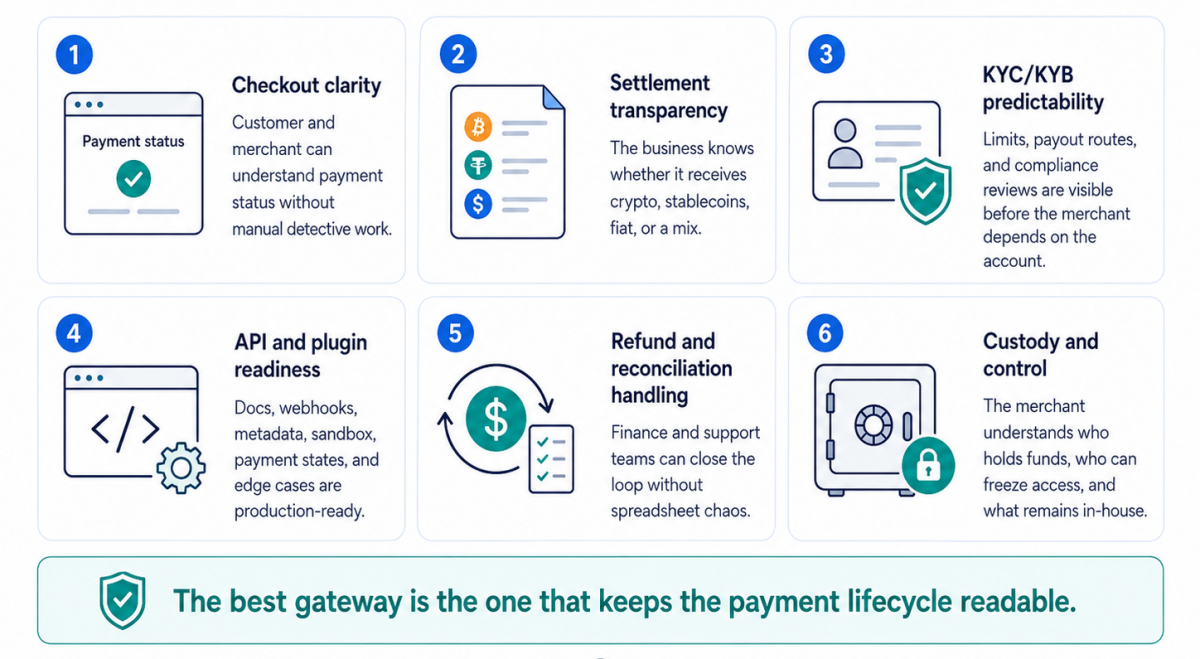
CryptoTotem’s merchant risk lens: six operational checks for choosing a crypto payment gateway.
The best gateway is not the one that wins a marketing table. It is the one that keeps the payment lifecycle readable.
Why Businesses Are Looking at Crypto and Stablecoin Payments
The strongest recent data points are not about speculative crypto volume. They are about business payment operations.
According to EY-Parthenon’s 2025 survey, the main use cases among organizations already using stablecoins were:
| Business Use | User Share |
|---|---|
| Paying suppliers cross-border | 62% |
| Accepting business payments cross-border | 53% |
| Cross-border liquidity, treasury, or cash management | 44% |
| Accepting consumer payments | 44% |
| Paying sub-merchants | 42% |
That changes how a merchant should read a “best crypto payment gateways” list. The question is not only “can customers pay with crypto?” It is also “can the business use crypto or stablecoins for supplier payments, treasury, payouts, settlement timing, and reconciliation?”
EY-Parthenon also reported that 41% of organizations already using stablecoins saw cost savings of 10% or more. That is a useful signal, not a guaranteed outcome for every merchant.
Fees, spreads, payout routes, compliance workload, and accounting complexity can erase part of the headline benefit if the gateway does not fit the business workflow.
Real Payment Volume vs Bull-Market Noise
Stablecoin payment demand is growing, but raw blockchain volume can be misleading. In BCG and Allium’s 2026 analysis of stablecoin payments, public blockchain data showed more than $62 trillion in annual stablecoin transfers, while real economic activity was estimated at about $4.2 trillion, roughly 7% of raw transfer volume.
For observable bilateral payments for goods and services, BCG and Allium estimated 2025 stablecoin payment volume at about $350-550 billion.
This matters for merchant decisions. A provider should not be chosen because the category has giant on-chain numbers. Choose it because the gateway solves a real payment problem: cross-border supplier payments, stablecoin settlement, lower payout friction, customer demand, or crypto-native checkout.
BCG and Allium also estimated that B2B payments made up about 40% of real-economy stablecoin payments and grew about 65% year over year. That supports a B2B-first reading of the market: stablecoin infrastructure is becoming more relevant to payments, treasury, and settlement, not only retail crypto checkout.
What the Deeper Research Changes
A deeper research pass adds four important points for merchants.
First, supplier and B2B workflows matter more than a simple “pay with crypto” button. EY-Parthenon’s five-year corporate interest data showed paying suppliers cross-border at 77%, accepting business payments cross-border at 49%, accepting domestic business payments at 37%, and accepting consumer payments at 31%. A merchant should therefore evaluate gateways by payout, settlement, reconciliation, and treasury fit, not only checkout conversion.
Second, adoption depends on network effects. EY-Parthenon found that 26% of corporates were ready to accept stablecoins, while about 60% would consider stablecoin payments if at least 20% of their vendors accepted them. For many businesses, the decision depends on whether suppliers, contractors, platforms, and payout partners can use the same rails.
Third, infrastructure fit is becoming a selection criterion. EY-Parthenon reported that 41% of corporates could integrate stablecoins with moderate effort, 36% expected major system changes, and only 6% were already integrated. The same research found that 63% preferred traditional banks or financial institutions as implementation partners, 56% preferred embedded APIs inside existing treasury or payment platforms, and about 70% became more willing to use stablecoins when the capability was integrated into ERP.
Fourth, market data needs caution. IMF research on international stablecoin flows shows that geography and flow estimates can diverge sharply depending on methodology. That reinforces the same editorial principle as the BCG/Allium data: do not choose a provider because the market has huge raw transfer numbers. Choose it because the payment flow is measurable, auditable, and useful for the merchant.
The practical takeaway: for B2B merchants, a crypto payment gateway is not just checkout software. It is part of the treasury, accounting, vendor-payment, compliance, and reconciliation stack.
Provider Taxonomy: Compare the Right Type of Gateway
Not every provider belongs in the same bucket. A simple checkout gateway, a self-hosted Bitcoin processor, and an enterprise stablecoin infrastructure provider solve different problems.
| Provider Type | What to Evaluate First |
|---|---|
| Checkout-first gateway | Checkout UX, plugins, payment states, refunds, underpayments, overpayments, customer support |
| Stablecoin settlement provider | Fiat/stablecoin payout options, supported networks, conversion, accounting, treasury fit |
| B2B / payout infrastructure | Supplier payments, sub-merchant payouts, KYB, reconciliation, liquidity, reporting |
| Self-hosted / non-custodial setup | Wallet security, hosting, backups, operational ownership, tax/accounting workflow |
| Enterprise / PSP rails | Licensing posture, transaction monitoring, settlement orchestration, API resilience, support SLAs |
This taxonomy prevents a common comparison mistake: judging infrastructure rails like Fireblocks or BVNK as if they were the same product type as a small ecommerce checkout plugin.
How We Selected the Best Crypto Payment Gateways
This is a curated comparison, not a universal ranking of every provider. CryptoTotem prioritizes merchant usefulness over bull-market noise. The core evaluation criteria are:
- supported coins and networks;
- processing fees and conversion costs;
- fiat, crypto, and stablecoin settlement;
- KYC/KYB requirements;
- ecommerce plugins and API quality;
- hosted checkout and invoice tools;
- custody model;
- geographic limits;
- refund, underpayment, and overpayment handling;
- reconciliation and reporting;
- quality of provider documentation;
- support during payment edge cases.
A gateway that works well for a crypto-native SaaS product may be a poor fit for a small ecommerce store. Broad coin support may be useful, but it does not compensate for weak settlement, unclear compliance, poor plugin maintenance, or fragile support.
What Is a Crypto Payment Gateway?
A crypto payment gateway is a service that lets a business accept cryptocurrency payments at checkout. It usually creates a payment address or invoice, detects the blockchain transaction, tracks confirmations, and helps the merchant settle funds in crypto, fiat currency, or stablecoins depending on the provider.
A simple wallet can receive crypto, but a payment gateway is built around merchant operations. It may add checkout pages, payment links, invoices, ecommerce plugins, API access, conversion tools, transaction reporting, payment status updates, and support workflows.
The gateway matters because it controls more than the payment button. It affects checkout UX, supported coins and networks, volatility exposure, accounting, refunds, compliance checks, and how quickly the merchant can access funds.
How Crypto Payment Gateways Work
Most crypto payment gateways follow the same basic flow:
- The customer chooses crypto at checkout.
- The gateway creates a payment request or invoice.
- The customer sends funds from a wallet or exchange account.
- The gateway monitors the blockchain transaction.
- The payment is marked as pending, confirmed, expired, underpaid, overpaid, or failed.
- The merchant receives settlement according to the provider’s rules.
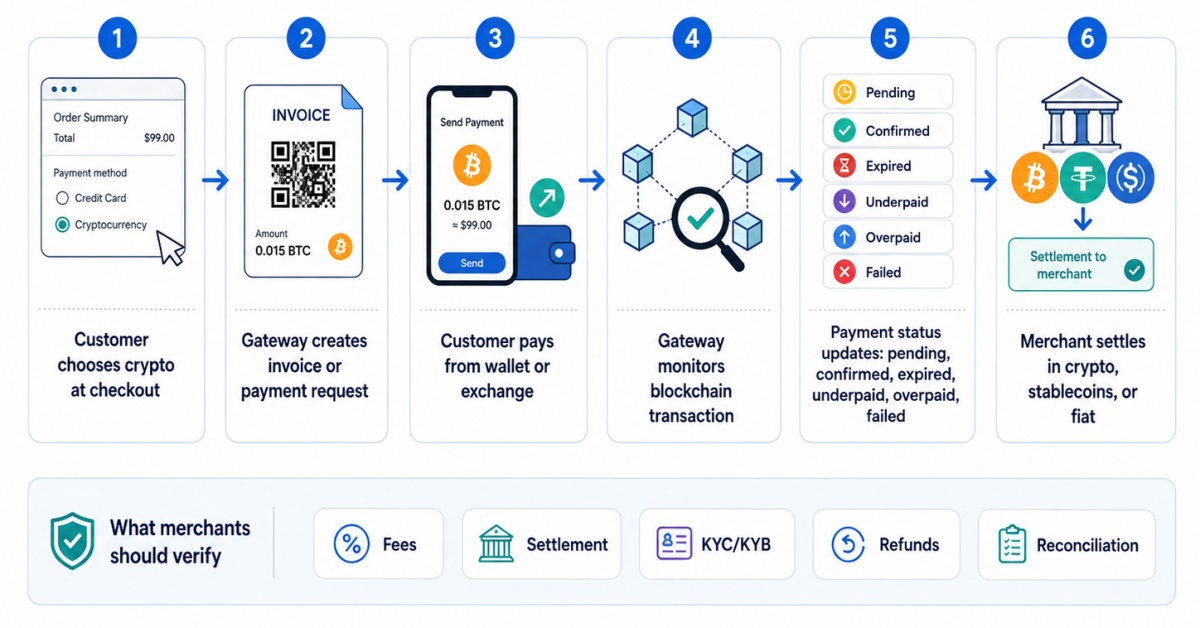
Crypto payment gateway workflow: from customer checkout and invoice creation to blockchain confirmation and merchant settlement.
The important merchant question is what happens after payment detection. Some gateways settle in crypto. Some convert to fiat. Some support stablecoin payouts. Some require a custodial account. Some leave more responsibility with the merchant.
A clean gateway makes these states visible. A weak gateway turns payment operations into Checkout Fog.
Custodial vs Non-Custodial Crypto Payment Gateways
A custodial crypto payment gateway can hold funds or manage settlement on behalf of the merchant. This may simplify fiat conversion, reporting, and managed checkout flows, but it can also introduce account approval, KYB, withdrawal limits, regional restrictions, and counterparty risk.
A non-custodial gateway usually sends funds directly to a merchant-controlled wallet. This can reduce reliance on the provider, but the merchant may need to handle wallet security, volatility, accounting, refunds, and conversion separately.
Neither model is automatically better.
A small ecommerce store may prefer a managed gateway with plugins and simple reporting. A crypto-native company may prefer API flexibility and stablecoin or direct-wallet settlement. A Bitcoin-focused merchant may prefer a self-hosted non-custodial setup like BTCPay Server. A regulated or higher-volume business may need stronger onboarding, reporting, and support.
When a Custodial Gateway May Be the Wrong Fit
A custodial provider can be useful, but it may not fit merchants that need immediate fund control, cannot tolerate payout delays, operate in a sensitive business category, or depend on fiat settlement that is not clearly available in their jurisdiction.
When a Self-Hosted or Non-Custodial Setup May Be the Wrong Fit
A non-custodial setup may not fit teams that cannot manage wallet security, hosting, backups, accounting, underpayments, overpayments, delayed confirmations, and support escalations. More control also means more responsibility.
Crypto Payment Gateway Fees Explained
Crypto payment gateway fees can include processing fees, blockchain network fees, currency conversion spreads, payout fees, withdrawal fees, and plan-based costs. A provider with a low advertised processing fee may still be expensive if conversion spreads, minimum payouts, or unsupported settlement workflows create extra operational cost.
When comparing gateways, check the full cost stack:
- processing fee per transaction;
- blockchain network fee handling;
- currency conversion spread;
- fiat payout or withdrawal fee;
- minimum payout amount;
- subscription or enterprise plan costs;
- refund-related operational costs;
- fees that vary by country, asset, network, or volume.
Current public provider documentation in this niche often shows gateway pricing signals around low-single-digit percentages, sometimes with fixed, network, payout, conversion, or volume-tier costs. Treat those numbers as benchmarks, not permanent terms. Recheck live pricing before publishing exact fees or integrating a provider.
KYC, KYB, Compliance, and Regional Restrictions
Many crypto payment gateways require KYC or KYB, especially when the provider offers custodial accounts, fiat settlement, bank payouts, or regulated merchant services. Non-custodial tools may have fewer onboarding requirements, but the merchant still needs to consider local laws, tax reporting, sanctions rules, and business-category restrictions.
This is where a provider can become a KYC Storefront: signup looks simple, but the real restrictions appear later through limits, payout routes, geography, compliance review, or account-stability risk.
Before integrating a gateway, check:
- whether the provider accepts businesses from your country;
- whether KYB is required before processing live payments;
- whether fiat settlement requires extra approval;
- whether your business category is restricted;
- whether customers from specific regions are blocked;
- whether payout rails match your accounting and treasury setup;
- whether limits change after volume increases.
Compliance is not a side note. EY-Parthenon found that 73% of organizations selected regulatory uncertainty as a top concern around stablecoins. FATF’s 2026 targeted report on stablecoins and unhosted wallets also reported that stablecoins accounted for 84% of illicit virtual asset transaction volume in 2025. That does not mean merchants should avoid stablecoins by default; it means KYT, AML controls, licensing posture, provider due diligence, and transaction monitoring belong inside the gateway-selection process.
API and Plugin Reality
“API available” does not mean “integration solved.” Many gateways market developer access as if it removes engineering work. In practice, a weak API can become API Promiseware: the endpoint exists, but production edge cases still fall on the merchant.
For a real payment integration, check whether the gateway supports:
- clear payment states;
- webhooks for confirmations, expirations, underpayments, and overpayments;
- metadata for matching orders and invoices;
- sandbox or test mode;
- reliable documentation;
- maintained ecommerce plugins;
- refund logic;
- stable checkout URLs;
- clear error handling;
- reconciliation exports.
A gateway with fewer coins but better payment-state handling may be safer than a gateway with hundreds of assets and weak operational clarity.
When an API-First Gateway May Be the Wrong Fit
An API-first provider may create more work than value if documentation is thin, webhooks are unclear, payment states are vague, sandbox testing is missing, or the merchant’s team cannot maintain the integration. API availability is not the same as production readiness.
EY-Parthenon’s corporate data supports this operational view: 56% of corporates preferred embedded APIs inside existing treasury or payment platforms, and about 70% became more willing to use stablecoins if the capability was integrated into their ERP. For B2B merchants, payment gateways should therefore be judged by ERP, accounting, treasury, payout, and reconciliation fit as well as checkout pages.
Why a Feature Table Is Not Enough
A crypto gateway can look excellent in a comparison table and still fail the merchant. Many assets, many plugins, and many badges can hide weak clarity when a payment goes sideways.
A serious merchant should test scenarios like:
- the customer sends the wrong amount;
- the customer uses the wrong network;
- the transaction confirms slowly;
- the invoice expires during payment;
- the customer asks for a refund after price movement;
- the order is paid, but the ecommerce platform does not update;
- the merchant account needs additional KYB before payout;
- support has to identify a transaction manually.
These moments reveal whether the gateway is infrastructure or just a polished payment button.
Risks Before Accepting Crypto Payments
Crypto payments can reduce card chargeback exposure and open checkout options for crypto-native customers, but they also create operational risks. Merchants should check volatility exposure, refund workflows, regulatory requirements, wallet security, settlement delays, accounting treatment, and provider restrictions before enabling crypto checkout.
The biggest risk is Checkout Fog: a payment flow that looks simple on the surface but hides unclear fees, unsupported countries, weak documentation, missing refund logic, or settlement terms that do not fit the business.
Other risks include:
- unsupported customer wallets or networks;
- payment delays during network congestion;
- underpaid or overpaid invoices;
- stale exchange rates;
- refund disputes caused by price volatility;
- unclear customer support ownership;
- accounting complexity across multiple assets;
- provider policy changes;
- compliance limits in specific regions.
A crypto payment gateway should reduce operational complexity, not hide it.
Final Checklist Before Choosing a Crypto Payment Gateway
Before signing up or integrating a provider, answer these questions:
- Does the gateway support the coins and networks customers actually use?
- Can the business settle in crypto, fiat, or stablecoins as needed?
- Are the fees, spreads, and payout costs clear?
- Is KYC or KYB required before live processing or payout?
- Does the provider support the merchant’s country and business category?
- Are plugins or API documentation current and maintained?
- Who controls the funds after payment?
- How are refunds, underpayments, and failed payments handled?
- Can the finance team reconcile transactions cleanly?
- Is customer support strong enough for payment issues?
- Can the gateway connect to ERP, treasury, accounting, or payout workflows if the use case is B2B?
- Does the provider have KYT/AML, licensing, and compliance coverage appropriate for the merchant’s jurisdiction and risk profile?
If any answer is unclear, do not treat the gateway as production-ready. Shortlist it, test it, and verify the missing details.
CryptoTotem Verdict
The best crypto payment gateway is not the one with the longest asset list. It is the one that keeps checkout status, settlement, compliance, and support understandable when something breaks.
The 2025-2026 evidence points in one direction: crypto gateways are becoming less about “accept many coins” and more about stablecoin settlement, cross-border B2B payments, payouts, ERP/treasury integration, and compliance-ready rails. That makes provider selection more serious, not less.
CryptoTotem’s practical recommendation: shortlist by use case, not by hype. Then test the payment flow before publishing it to customers. The real gateway is not the marketing page. It is the moment when the customer pays, the order updates, the merchant settles, and support does not need to guess what happened.
Frequently Asked Questions
What Is the Best Crypto Payment Gateway for Businesses?
The best crypto payment gateway depends on the business model. Ecommerce stores often need plugins, stable checkout, and fiat settlement. Crypto-native businesses may prioritize API flexibility, supported networks, non-custodial settlement, and stablecoin support. B2B companies may care more about supplier payments, stablecoin settlement, payouts, ERP integration, and reconciliation. Merchants should verify current fees, KYC/KYB, countries, and settlement terms before integration.
What Is a Crypto Payment Gateway?
A crypto payment gateway is a service that helps businesses accept cryptocurrency payments. It usually creates payment requests, monitors blockchain transactions, tracks confirmations, and helps settle funds in crypto, fiat, or stablecoins depending on the provider.
Do Crypto Payment Gateways Require KYC or KYB?
Many custodial or fiat-settlement gateways require KYC or KYB, especially for businesses. Non-custodial tools may have fewer onboarding requirements, but merchants still need to consider compliance, tax, reporting, sanctions, and local legal obligations.
Can Businesses Settle Crypto Payments in Fiat?
Some crypto payment processors offer fiat settlement, but support depends on the provider, country, currency, business category, and account approval. Merchants should verify current availability directly before launch.
Which Crypto Payment Gateways Support Ecommerce Plugins?
Several providers market ecommerce integrations or plugins. Plugin availability should be verified against the merchant’s platform version, checkout flow, order-state handling, and support needs.
Are Crypto Payment Gateways Safe?
A crypto payment gateway can be safe when the provider has clear documentation, secure checkout flows, transparent fees, reliable settlement, and appropriate compliance controls. Merchants also need wallet security, refund procedures, accounting processes, and support workflows.
What Fees Do Crypto Payment Processors Charge?
Fees may include processing fees, network fees, currency conversion spreads, payout fees, withdrawal fees, and subscription or volume-based costs. The advertised processing fee is only one part of the total cost. Current provider pages should be rechecked before publishing exact fees or integrating a gateway.
Why Are Stablecoins Important for Business Payments?
Stablecoins can reduce volatility compared with non-stable crypto assets and can support cross-border settlement, supplier payments, payouts, and treasury workflows. EY-Parthenon’s 2025 survey found that paying suppliers cross-border was the leading use case among current stablecoin users, and BCG/Allium estimated $350-550 billion in observable bilateral stablecoin payments for goods and services in 2025. Those figures support stablecoins as a real payment rail, but not as a reason to skip compliance, reconciliation, or provider due diligence.
Can Small Businesses Accept Bitcoin Payments?
Yes. Small businesses can accept Bitcoin through a managed payment gateway, hosted checkout, wallet-based flow, or a self-hosted tool such as BTCPay Server. The right setup depends on technical capacity, settlement needs, accounting, and customer support.
What Is the Difference Between a Crypto Payment Gateway and a Crypto Wallet?
A wallet stores and sends crypto. A payment gateway manages merchant checkout, payment detection, confirmations, settlement options, order status, and sometimes fiat conversion or ecommerce integration.
Should Merchants Use a Custodial or Non-Custodial Crypto Payment Gateway?
Custodial gateways can simplify settlement and fiat conversion but may require account approval and introduce provider risk. Non-custodial gateways give merchants more direct control over funds but require stronger wallet, accounting, and operational processes.