


Mastercard recently announced plans to expand its settlement capabilities using stablecoins (like USDC and PYUSD) across multiple blockchains. Their primary goal? To enable intraday, holiday, and weekend settlements.
This move by a traditional finance pillar validates the market’s demand for capital efficiency. For high-velocity digital industries-ranging from iGaming operators managing continuous liquidity to scaling AI SaaS platforms processing thousands of global micro-subscriptions-waiting for traditional banking windows to access revenue is no longer a minor friction; it is a significant strategic liability. The commercial conversation has shifted from simply “accepting crypto” as an alternative payment method, to optimizing how rapidly stablecoin liquidity can be converted into working fiat capital.
The Payment Bottlenecks Facing High-Velocity & High-Risk Merchants in 2026
Despite broader stablecoin adoption, high-volume merchants continue to face operational friction when scaling crypto payments. Common challenges include:
- Failed payments caused by incorrect network selection or insufficient gas fees.
- Market volatility exposure between the time a user pays and the merchant settles the transaction.
- Settlement delays that restrict access to working capital.
- Lengthy fiat withdrawal reviews and high friction in traditional banking channels.
- Limited visibility into cross-border transactions, multi-jurisdiction compliance, and payout records.
For iGaming operators managing continuous liquidity and AI SaaS platforms handling thousands of global micro-subscriptions, payment performance is fundamentally a growth metric. A failed deposit or subscription payment directly translates to lost revenue from a user with confirmed purchase intent. For these merchants, optimizing checkout completion and accelerating liquidity access has a far greater impact on the bottom line than standard integration concerns.
Comparing Crypto Payment Gateways for Enterprise Operations
When evaluating crypto payment gateways, merchants increasingly prioritize operational fit, settlement speed, and compliance over simple asset coverage.
Coinbase Commerce
- Best suited for: Businesses prioritizing regulatory credibility and mainstream brand recognition.
- Overview: Coinbase Commerce benefits from a mature compliance framework and strong market presence. However, strict onboarding requirements and rigid settlement flexibility often make it less viable for scaling high-risk industries or agile global SaaS platforms.
CryptoProcessing
- Best suited for: Enterprises requiring structured AML controls and traditional multi-jurisdiction support.
- Overview: The platform offers robust compliance infrastructure but frequently requires longer implementation cycles, dedicated operational resources, and heavier fee structures.
BitPay
- Best suited for: Traditional merchants seeking an established, compliance-oriented payment provider.
- Overview: While operationally stable and widely recognized, high-velocity merchants often encounter friction regarding checkout flexibility and rigid fiat payout workflows.
CCPayment
- Best suited for: iGaming, AI SaaS, and cross-border platforms requiring the optimal balance between FinCEN-registered compliance, low-friction checkout, and instant liquidity access.
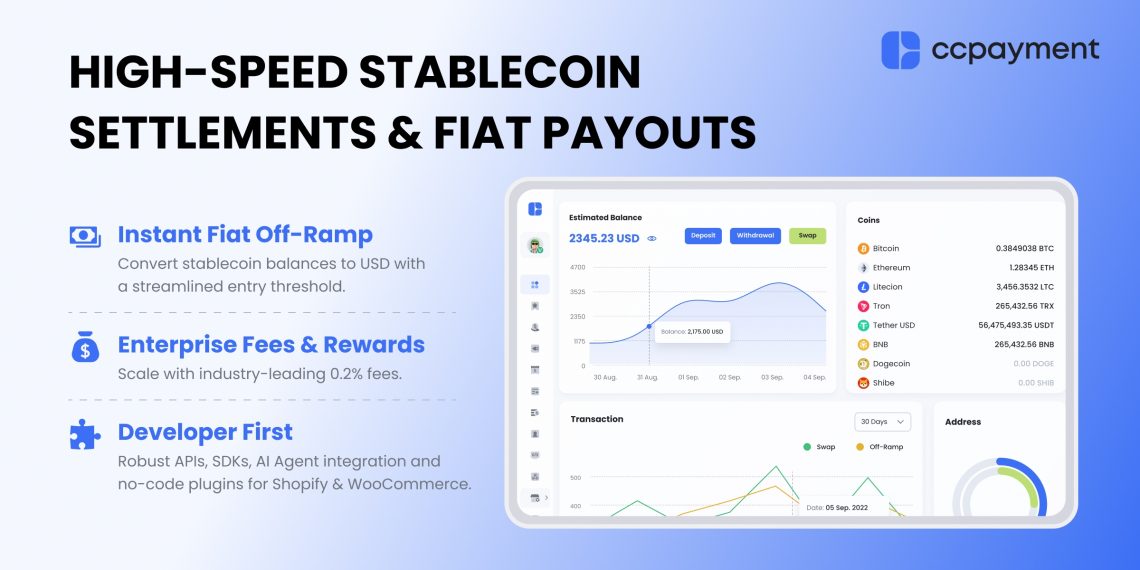
- Overview: CCPayment delivers institutional-grade infrastructure by combining auto-swap stablecoin settlements, an industry-leading tiered fee structure (0.5% down to 0.2%), unified merchant ledger visibility, and dedicated SWIFT fiat off-ramps within a highly streamlined operational framework.
What Merchants Should Evaluate Beyond Fees
Processing fees remain important, but they rarely represent the full operating cost of a payment system.
Merchants should also evaluate:
- Checkout Performance: Can users complete payments without confusion around networks, gas fees, or payment status?
- Settlement Flow: How quickly do funds become available for business operations? Can incoming volatile assets be automatically converted into stablecoins (USDT/USDC) instantly?
- Liquidity Access: Can stablecoin balances be routed into global bank accounts as working fiat capital without week-long delays?
- Regulatory Perimeter: Does the provider maintain licensing (such as MSB registration), AML controls, and risk-management protocols that protect merchant funds?
- Merchant Ledger Visibility: Can finance and operations teams reconcile deposits, settlements, balances, and payouts through a unified ledger?
In practice, these factors often have a greater impact on operational efficiency than small differences in transaction fees.
CCPayment’s Approach: From Checkout to SWIFT Off-Ramp
CCPayment is designed around the operational requirements of high-volume and high-risk merchants, including iGaming operators, AI SaaS platforms, and cross-border businesses.
The platform combines licensed infrastructure with a focus on:
- Stablecoin payment processing: Features instant auto-swaps to USDT/USDC upon transaction confirmation to eliminate market volatility.
- Checkout optimization: Operates on a highly competitive tiered fee structure as low as 0.2% to protect merchant profit margins.
- Merchant ledger visibility: Provides a unified dashboard to reconcile deposits, settlements, and payout records in real-time.
- Settlement and payout management: Supports automated mass payouts and flexible API integration for high-frequency operations.
- Multi-market compliance support: Backed by FinCEN-registered MSB licensing and structured AML controls.
To address one of the operational challenges merchants face after receiving stablecoin payments, CCPayment recently introduced a streamlined Sell USDT service (via SWIFT) that enables merchants to convert stablecoin balances into USD through a simplified KYC process. With a lower entry threshold starting from 2,000 USDT and a streamlined review workflow, the service is designed to make USD conversion more accessible for a broader range of merchants—ensuring that working capital is readily available for SaaS infrastructure costs, iGaming payouts, or cross-border settlements.
Final Thoughts
As the crypto payment landscape matures, the enterprise discussion has permanently shifted from token counts to capital efficiency.
For global iGaming operators, cross-border e-commerce networks, and scaling AI SaaS platforms, the most effective payment gateway is the one that reliably accelerates the entire financial lifecycle, from the initial user checkout to automated stablecoin settlement, and ultimately to corporate fiat payouts.
In 2026 and beyond, checkout conversion rates, SWIFT settlement efficiency, and predictable liquidity management are the absolute defining metrics for evaluating Web3 payment infrastructure.
Connect with CCPayment: For the latest API updates, SaaS insights, and Web3 payment trends, join our growing community:
- Website: https://ccpayment.com
- X (Twitter): https://x.com/CCPaymentX
- LinkedIn: https://www.linkedin.com/company/ccpayment
- Official Channel: https://t.me/ccpayment_com
- 24/7 API Support: @CCPaymentSupportBot
Disclaimer: This is a sponsored press release, and is for informational purposes only. It does not reflect the views of CryptoTotem, nor is it intended to be used as legal, tax, investment, or financial advice. The author or the publication does not hold any responsibility, directly, or indirectly, for any damage or loss caused or alleged to be caused by or connected with the use of or reliance on any content, goods or services mentioned in this article. Readers should conduct their own research before taking any actions related to this company.