


By CryptoTotem Research · Research cutoff: September 29, 2026 · 5-minute read
Main Result. Transaction monitoring and blockchain analytics each appeared in 12 of the 19 reviewed provider profiles. Yet operationally detailed evidence-export information appeared for only two providers in the original corpus. A useful provider demo should show a complete customer case, the services it depends on, and an export your team can inspect outside the vendor interface.
Our study of 19 compliance providers with a documented EU connection was first published by SpazioCrypto on October 6, 2026, as KYC and AML for European CASPs: What 19 Vendor Documents Reveal. This follow-up turns its findings into five checks before choosing know-your-customer (KYC) and anti-money laundering (AML) tools.
Reading Rule. The findings describe selected public documents. An unknown means the research did not establish an answer; it does not confirm that a function is absent. The tests below are proposed buying checks, not a complete legal checklist.
1. Ask Which Part of the Workflow the Feature Covers
Twelve of the 19 profiles described or claimed transaction monitoring, and the same number described or claimed blockchain analytics. Travel Rule functionality appeared in seven.
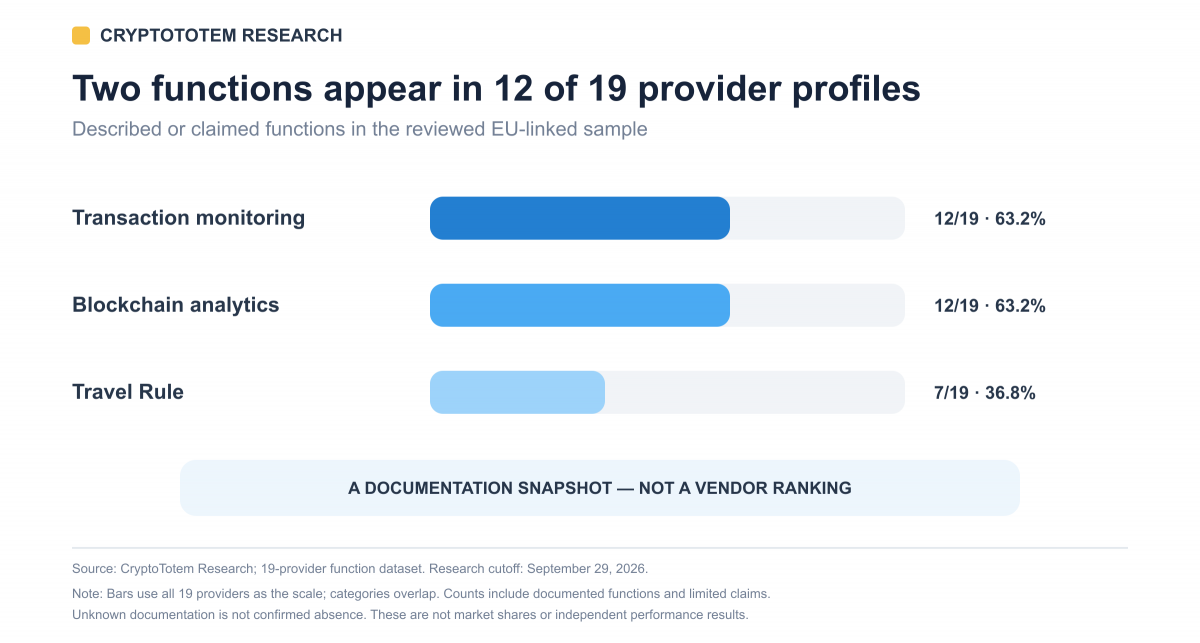
Monitoring and blockchain analytics each appeared in 12 of the 19 profiles; Travel Rule appeared in seven
Those categories answer different questions. A blockchain-risk result does not prove that the required counterparty information was exchanged. Delivery of a Travel Rule message does not, by itself, demonstrate that the transfer’s risk was assessed.
Ask the supplier to show where each result enters your process, what identifiers connect it to the customer and transfer, and what happens when a stage cannot be completed. Record the boundaries of the proposed configuration before discussing additional modules.
2. Check the Evidence Behind Each Function
A targeted second desk review reclassified four function cells after examining more detailed documentation. The broad category totals stayed the same, but the distinction between an operational description and a limited claim changed.
That is a useful reminder for buyers: a sparse research entry may reflect incomplete discovery. Request the current technical document for your intended use case, then ask the provider to demonstrate it. Compare the product claim with the implementation documentation and the recorded outcome of a test using your intended configuration.
Save the demo configuration: enabled modules, data sources, rules, manual steps and exception paths. Otherwise, a successful example may depend on a service, data source or manual step absent from the commercial proposal.
3. Identify the Dependencies Behind the Interface
An integrated interface can combine several companies’ services. Record who supplies the data, who operates the workflow, which entity is responsible under your contract and who must resolve a dependency failure. For customer data, also request the applicable processing terms, storage locations, retention settings and deletion process for your proposed configuration.
Ask for a failure demonstration: an unavailable data source, delayed response or missing counterparty connection. Check whether your team sees the problem, whether processing pauses, and who can approve the next step. The purpose is to understand the operating arrangement rather than reward a long list of partner logos.
4. Export a Completed Case
Only two providers had operationally detailed evidence-export information in the original reviewed corpus. That does not mean the other 17 cannot export records; the research did not establish a complete inventory of their documentation.
For the intended configuration, request a sample export containing the original inputs, results, relevant rule version, reviewer decisions, timestamps and reasons for closure. Ask the provider to identify any missing fields and explain the limitations. Then inspect it outside the vendor’s interface. Could another reviewer reopen the exported file later and reconstruct the decision without help from the person who ran the demo?
This is a proposed acceptance test, not a statement that every field has the same legal retention requirement in every jurisdiction.
5. Test an Exception Before the Routine Workflow
Use a hypothetical corporate customer whose ownership information conflicts with a registry record. Add a possible screening match and incomplete transfer information. Ask who resolves each issue and where the reasoning remains visible.
Agree acceptance criteria before the test: unresolved issues remain visible, decisions have an owner, and the final record connects the separate stages. Also ask what happens if a supplier changes or your firm needs its historical records after termination.
Under Article 73 of the EU’s Markets in Crypto-Assets Regulation (MiCA), a crypto-asset service provider (CASP) that outsources operational functions remains fully responsible for its obligations under Title V. That makes internal oversight part of the purchase decision.
Before the Provider Meeting
Before the meeting, send the supplier four requests: the exact service scope; the dependency list; a sample case export; and an exception scenario for a live walkthrough. These will give your team more concrete material to assess than a generic feature comparison.
If you are building a shortlist, our KYC and AML provider guide can help you identify the types of services to examine. The guide is a separate navigation resource, not the study’s dataset.